
What Causes Mould Under Carpets After Cleaning and How to Avoid It
You had the carpet cleaned to freshen the room, and a few days later something is wrong: a faint musty smell that lingers no matter how often you open the windows, or a patch of pile that feels stubbornly cool and damp underfoot. It feels deeply counter-intuitive that cleaning could leave a carpet worse than before, but mould developing beneath a freshly cleaned carpet is a real and surprisingly common problem. The good news is that it is almost entirely preventable once you understand what causes it. In nearly every case the culprit is not the cleaning itself but moisture that was never allowed to dry properly, and the conditions that let it linger. This guide walks through why it happens, how to recognise it early, and the practical steps that keep it from taking hold at all.
Why Mould Can Appear After a Carpet Clean
Cleaning a carpet, by almost any method, introduces water. The skill lies not in avoiding moisture but in removing it again quickly and thoroughly, and this is precisely where problems begin. A carpet that looks dry on the surface can still be holding a great deal of water deeper in the pile, in the backing, and in the underlay beneath it, none of which you can see or easily feel.
When that residual moisture sits undisturbed in a warm, dark, poorly ventilated space, it creates the ideal nursery for mould spores, which are present in the air of every home and need only damp and time to take hold.
The Moisture That Never Fully Dried
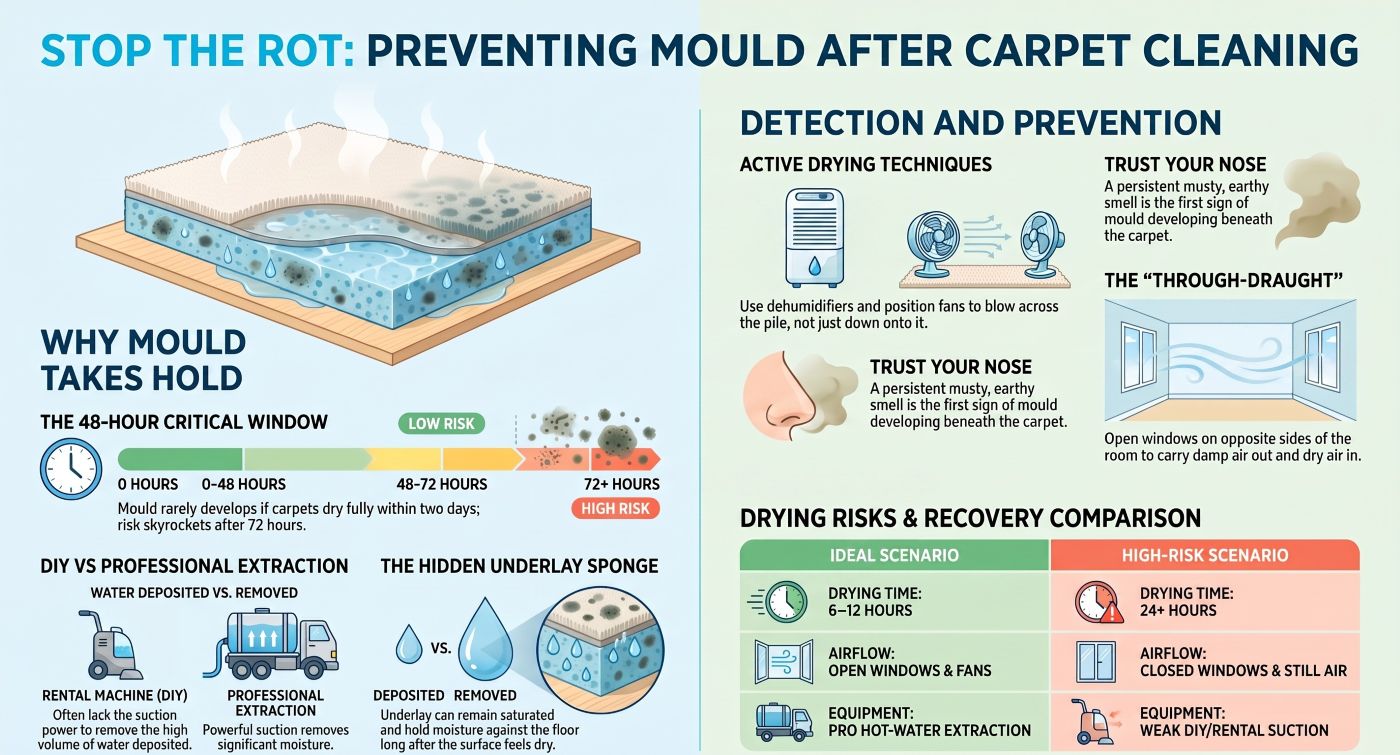
The mould you eventually smell or see is the visible end of a process that started with water left behind. Surface fibres dry first because they are exposed to air, which makes the problem deceptive: the top of the carpet feels dry while the layers underneath remain saturated. That hidden reservoir, trapped against the floor with nowhere to evaporate, is what feeds growth in the days following a clean.
Over-Wetting: The Single Biggest Culprit
If there is one cause behind the majority of post-cleaning mould, it is using too much water and extracting too little of it back out. A carpet that has been genuinely over-wetted can take days to dry through every layer, and every additional hour of dampness widens the window in which mould can establish itself.
Professional hot-water extraction is built around powerful suction that pulls the bulk of the moisture straight back out, leaving the carpet damp rather than soaked. The trouble arises when that balance tips towards saturation and the extraction cannot keep pace.
Why Rental and DIY Machines Make It Worse
Domestic and rental cleaning machines are the most frequent offenders. Their suction is far weaker than professional equipment, so they tend to lay down more water than they can recover, leaving the carpet markedly wetter at the end of the job. It is also easy, with no training, to go over an area repeatedly chasing a stubborn mark, pouring in more solution each time. The result looks clean for an afternoon but stays wet far longer than it should.
How Underlay and Subfloor Trap Damp
The carpet you can see is only the top layer of a sandwich. Beneath it sits the underlay, and beneath that the subfloor, and both decide whether trapped moisture clears or festers. Underlay in particular acts like a sponge, soaking up water that drains down through the carpet backing and holding onto it long after the pile above feels dry.
Because the underlay is sealed between carpet and floor, the moisture it holds has almost no route to evaporate, so it can sit damp for days while mould quietly develops out of sight.
Concrete and Timber Behave Differently
The floor underneath matters too. A solid concrete subfloor does not absorb water, so any moisture that reaches it simply pools and stays put unless drawn back upward. A timber subfloor can absorb damp and, if it stays wet, is itself vulnerable to rot and mould. Either way, once moisture passes below the carpet it becomes very difficult to remove without lifting the floor covering entirely, which is why preventing over-wetting in the first place matters so much.
The Conditions Mould Needs to Grow
Mould is not a matter of bad luck; it is a matter of specific conditions being met. Spores float in the air of every room, harmless until they find what they need. Give them moisture, a temperature roughly between fifteen and thirty degrees, a food source such as the dust and organic fibres in any carpet, and stillness with little airflow, and growth becomes a near certainty.
Remove any one of those factors and you break the chain. Moisture and airflow are the two we have most control over after a clean, which is why nearly all sensible prevention focuses on drying fast and keeping air moving.
The Critical First 48 Hours
The first two days after cleaning are when the outcome is decided. A carpet that dries fully within this window rarely develops mould, while one still damp after two or three days is at serious risk. A clean carried out on a cold, still day with the windows shut is far riskier than the same clean with heating on and air circulating. Speed of drying, more than anything else, determines whether you have a problem.
How to Spot Mould Developing Beneath the Pile
Because the trouble begins underneath, you will usually notice it through your nose before your eyes. Catching it early gives you the best chance of dealing with it before it spreads into the underlay and subfloor, where it becomes far harder to resolve.
A persistent musty, earthy smell that does not lift with airing is the classic first sign, and it is worth taking seriously even when nothing looks amiss on the surface.
Musty Odours and Creeping Stains
Beyond the smell, watch for discolouration spreading up through the pile – patches of grey, green or black that were not there before the clean – and for areas that stay damp or cool underfoot for far longer than the rest of the room. Some people also notice a return of allergy-like symptoms, such as a stuffy nose or irritated eyes, in the affected room. Any of these, particularly in combination, warrants a closer look at the carpet and the floor beneath it.
Drying a Carpet Properly After Cleaning
Prevention comes down almost entirely to drying the carpet quickly and completely, and there is a great deal you can do to help. The aim is to pull moisture out of the room and keep fresh air moving across the pile until every layer is dry, not just the surface.
Ventilation is the foundation. Opening windows to create a through-draught, even for a short while, dramatically speeds evaporation by carrying damp air out and drawing dry air in.
Airflow, Heat and Dehumidifiers
Beyond simply opening up, a few measures make a real difference. Position fans to blow across the carpet rather than down onto it, keeping a constant stream of air moving over the fibres. Gentle background heating raises the air’s capacity to hold moisture, helping it evaporate faster, though fierce direct heat is best avoided. A dehumidifier is perhaps the single most effective tool, actively stripping water vapour from the air so the carpet can release its moisture into a drier room. Used together in the first day or two, these turn a slow, risky dry into a fast, safe one.
Why Period Homes in North London Are More Vulnerable
Where you live shapes the risk, and the older housing stock of North London deserves particular care. The Victorian and Georgian terraces that fill much of Islington were built long before modern damp-proofing and ventilation standards, and many carry a baseline level of background damp that a careless carpet clean can tip over the edge.
Solid ground floors, original construction and naturally cooler, less ventilated rooms all slow drying and give moisture more chance to settle.
Solid Floors and Poor Ventilation in Older Terraces
Garden and basement flats across the borough are especially prone, sitting close to or below ground level where damp rises and air moves sluggishly. In these homes the margin for error is thin: a carpet that might dry overnight in a bright, airy upper-floor flat can stay damp for days in a cool lower-ground room off a quiet Islington street. The practical lesson is to be doubly diligent about drying – more ventilation, longer dehumidifier use, and patience – in any home with these older characteristics.
When the Problem Needs a Professional
There comes a point where home drying is not enough. If a musty smell persists for more than a week despite thorough airing, if you can see discolouration spreading through the pile, or if the dampness reaches into the underlay and subfloor, the issue has moved beyond what fans and open windows can fix. At that stage the carpet may need lifting so the layers beneath can be inspected, dried and treated, and any growth dealt with at its source rather than masked at the surface. Professional moisture meters can confirm whether damp remains hidden below, and proper remediation addresses the underlay and floor as well as the carpet. Recognising when a problem has outgrown a domestic fix is part of protecting both the carpet and the room it sits in.
Frequently Asked Questions
How long should a carpet take to dry after cleaning? With good ventilation and proper extraction, most carpets dry within six to twelve hours. Anything still damp after twenty-four hours suggests over-wetting or poor airflow and raises the risk of mould.
Can mould under a carpet make you ill? It can. Mould spores may aggravate allergies, asthma and other respiratory conditions, so persistent damp and musty smells beneath a carpet are worth addressing promptly rather than ignoring.
Does professional cleaning cause mould? Properly done, no. Professional hot-water extraction removes the great majority of moisture, leaving the carpet damp rather than soaked. Mould tends to follow over-wetting, weak extraction or slow drying instead.
Can I save a carpet that already has mould underneath? Sometimes. Minor, recently developed mould caught early can often be dried out and treated, but growth that has spread into the underlay and subfloor may require those layers to be replaced.