
Getting Felt-Tip and Biro Marks Out of a Child’s Bedroom Carpet
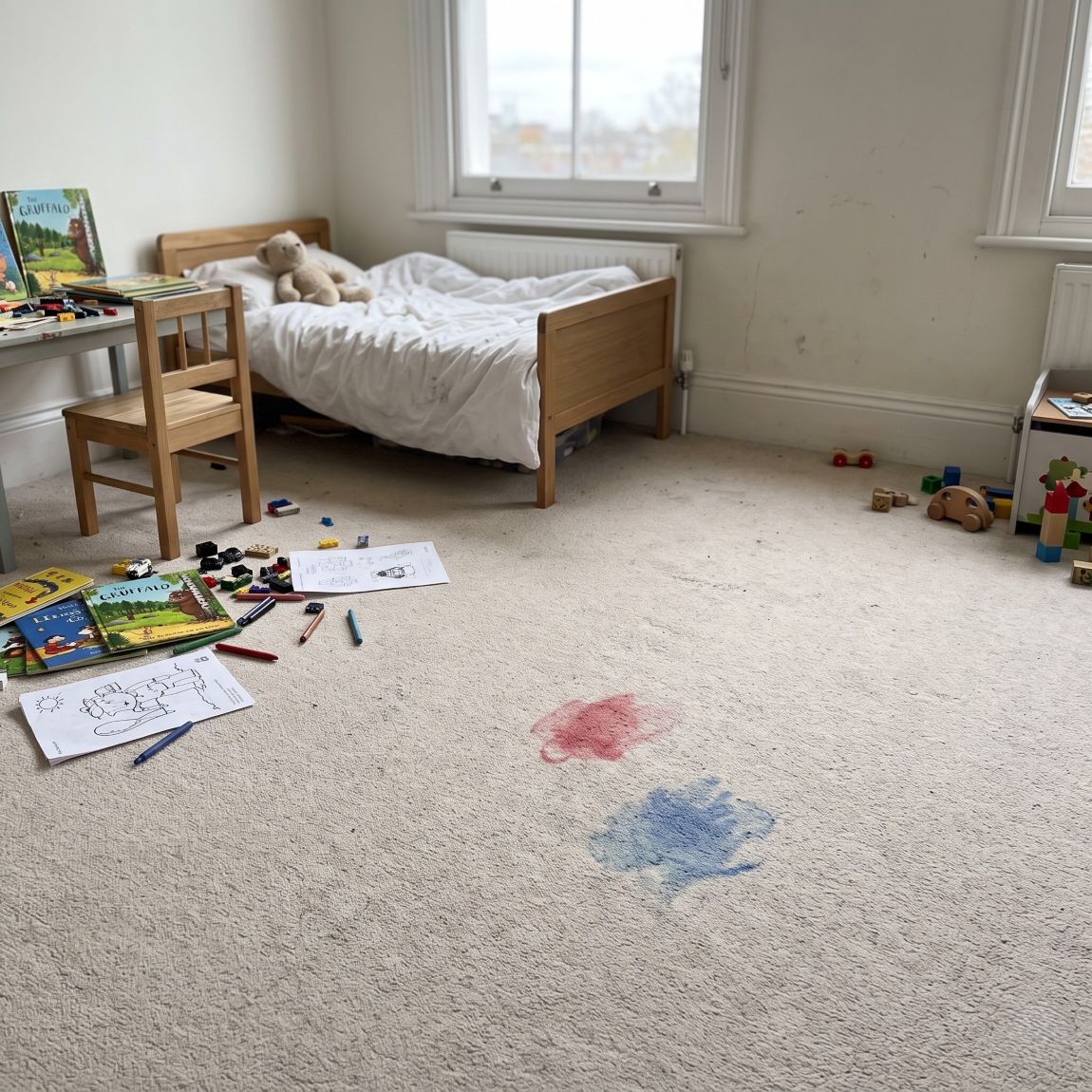
You walk into your child’s bedroom and there it is: a felt-tip mural blooming across the carpet, or a tight knot of biro scribble where a drawing strayed off the paper. The first thing to know is that both marks are, in the great majority of cases, recoverable – provided you tackle them correctly and resist the urge to scrub. The second is that felt-tip and biro are not the same problem wearing different colours. They are chemically distinct, they respond to entirely different treatments, and the most common mistake parents make is treating them as interchangeable. What follows is a calm, methodical guide to each one, drawn from years of lifting these stains out of bedroom carpets across North London.
Why Felt-Tip and Biro Stains Behave So Differently
It is tempting to lump all pen marks together, but the chemistry underneath tells a different story. Why one stain lifts with a drop of washing-up liquid while another laughs at soapy water comes down to what is actually carrying the colour, and that distinction separates a clean recovery from a set-in patch you live with for years.
Most children’s felt-tips, particularly the washable ranges marketed for younger children, use water-based dyes. These are designed to come out of clothing, so cool water and a mild detergent will often shift a good deal of the colour on their own. Biro, by contrast, uses an oil- or alcohol-based paste engineered to flow smoothly and dry fast on paper, and it shrugs off water entirely. Sitting awkwardly between the two are permanent markers, which are felt-tips in shape but solvent-based in soul, and which behave far more like biro when they hit the floor.
How Carpet Fibres Hold the Pigment
Carpet is not a flat surface; it is a dense forest of twisted or looped fibres, and ink works its way down between them rather than resting on top. Pigment that has sunk towards the base of the pile is harder to reach than the colour you can see, and worse, dye can wick back up the fibre as the carpet dries, so a stain that looked beaten can reappear hours later. This is precisely why patience and repeated, gentle applications beat one aggressive assault every time.
What to Do in the First Few Minutes
Speed is your greatest ally, but speed used badly does more harm than the stain itself. The actions you take in the first few minutes – before any product comes near the carpet – largely decide how much work the rest of the job will be.
The instinct almost everyone has is to rub, and it is exactly the wrong one. Rubbing drives pigment deeper into the pile and smears it outward, turning a coin-sized mark into a saucer-sized one and pushing colour towards the backing where it is far harder to retrieve.
Blot, Never Rub
Take a clean white cloth or a wad of kitchen roll and blot the mark gently, working from the outside edge inward so you gather the ink towards the centre rather than spreading it. Use white cloth specifically, because a coloured or patterned cloth can transfer its own dye into a damp carpet. Lift, turn to a clean section, and blot again – you are lifting ink, not grinding it.
Testing an Inconspicuous Area First
Before applying any solution, test it on a hidden patch – under the bed, behind a wardrobe, or along the edge by the skirting. Many of Islington’s Victorian and Georgian conversions still have original or wool-rich carpets that can react badly to solvents, and a thirty-second test spares you a bleached patch in the middle of the room.
How to Remove Felt-Tip Pen from Carpet
For ordinary, washable felt-tip, the gentlest effective method is almost always a household one, and you should exhaust it before reaching for anything stronger.
Mix a teaspoon of washing-up liquid into a cup of cool water – never warm, for reasons covered below – and add a tablespoon of white vinegar. Dampen a white cloth, wring it so it is moist rather than wet, and dab it onto the stain. Let it sit for around five minutes so the detergent can work into the dye, then blot with a clean dry cloth.
The Washing-Up Liquid and White Vinegar Method
Repeat the cycle – dab, dwell, blot – as many times as it takes, and expect the colour to lift a little more with each pass. Most washable felt-tip surrenders within a handful of repetitions. Once the stain has gone, blot with plain cool water to rinse away detergent residue, which would otherwise attract dirt, then press a dry towel down firmly to draw out the moisture.
When Surgical Spirit Is Needed for Permanent Marker
If the culprit turns out to be a permanent marker, the water-based method will make little headway and you will need to escalate to surgical spirit. Decant a small amount onto a white cloth, never directly onto the carpet, and dab carefully, blotting frequently as the ink dissolves. Open a window first, keep the application sparing, and stop the moment the colour stops transferring to your cloth.
How to Remove Biro and Ballpoint Ink from Carpet
Biro demands a solvent from the outset, because water simply beads off the oily paste and achieves nothing. The good news is that ballpoint ink, while stubborn, responds well to alcohol-based treatment when you are methodical.
Surgical spirit or isopropyl alcohol is the reliable workhorse here. As with permanent marker, the cardinal rule is to apply it to the cloth rather than the carpet, which keeps the solvent from spreading the dissolved ink outward and soaking the backing.
Using Surgical Spirit or Isopropyl Alcohol
Moisten a white cloth, press it onto the biro mark, and hold for a few seconds to let the alcohol break down the ink. Then blot, turning to a fresh part of the cloth each time so you are always lifting onto a clean surface. Work inward from the edges: several light passes will outperform one heavy soaking, and they protect the pile while they do it.
Why Hairspray Is a Mixed Blessing
You will have seen the old hairspray tip, and it is worth being honest about it. Hairspray used to work because it was loaded with alcohol, the active ingredient doing the real work. Many modern formulations have far less alcohol and more resin and conditioner, so they often fail to shift the ink while leaving a sticky residue that attracts dirt. Surgical spirit gives you the alcohol without the additives, which is why it remains the dependable choice.
Mistakes That Set the Stain Permanently
Some well-meant interventions do not merely fail; they lock the stain in for good, and a few of these errors are genuinely irreversible.
Heat is the chief villain. Warm or hot water, and the warm air from a hairdryer aimed hopefully at a damp patch, can chemically set dye into the fibre, turning a liftable mark into a permanent one. Cool water, always.### Heat, Hot Water and Over-Wetting
Over-wetting carries its own dangers. Saturating the carpet pushes pigment into the backing, encourages the wicking that brings stains back as it dries, and in the dense period flooring common across North London terraces it can leave moisture trapped against the underlay, where it invites mould and lingering odour. Keep your cloths moist, not dripping.### Reaching Straight for Bleach or Harsh Solvents
The other temptation is to reach for the strongest thing in the cupboard. Bleach, acetone and undiluted industrial cleaners can strip the colour from the carpet itself, leaving a pale, hard-edged blotch far more conspicuous than the original ink. Aggressive chemistry is almost never the answer on a child’s bedroom floor.
Wool, Synthetic and the Carpets Common in Islington Homes
The right approach depends partly on what your carpet is made of, and the local housing stock makes this more than academic. The grand conversions off Upper Street and the family homes of Canonbury and Highbury frequently feature wool or wool-blend carpets that need a gentler hand than synthetics.
Wool is a natural protein fibre, sensitive to strong alkalis and to vigorous treatment that can felt or distort the pile. Milder solutions, lighter pressure and a slower, more patient rhythm suit it far better.
Caring for Wool and Wool-Blend Carpets
With wool, lean towards the dilute washing-up liquid approach, keep vinegar weak, and test any solvent with particular care, since wool can mark and roughen if pushed too hard. Blot rather than scrub throughout, and give the fibre time to recover between passes.### Treating Polypropylene and Nylon
Synthetic carpets such as polypropylene and nylon are generally more forgiving. They tolerate solvents better and many are manufactured with stain resistance built in, so you can treat them a little more robustly – though the principles of blotting, working inward and avoiding heat still hold.
When to Call a Professional Carpet Cleaner
There is a point at which home methods have done all they reasonably can. A stain left for weeks, one covering a large area, or one already treated several times with diminishing returns is a candidate for professional attention. Set-in dye that has reached the backing, and the faint shadow that sometimes lingers once the bulk of a stain has gone, often respond to professional hot-water extraction and specialist spotting agents not sold for home use. Knowing the limit of what a cloth and a bottle of surgical spirit can achieve is part of looking after a carpet well.
Frequently Asked Questions
Does dried biro come out of carpet? Often, yes. Dried ballpoint ink is harder than a fresh mark but still responds to surgical spirit or isopropyl alcohol applied to a cloth and blotted patiently in repeated light passes.
Will felt-tip stain my carpet permanently? Usually not, if it is washable felt-tip and you avoid heat. Cool water with mild detergent and white vinegar lifts most water-based ink; permanent markers are the exception and need solvent treatment.
Can I use nail varnish remover on biro? It is risky. Acetone-based removers can dissolve synthetic carpet fibres and strip colour, so surgical spirit is the safer, more controllable option.
How long should I leave white vinegar on a felt-tip stain? Around five minutes per application is plenty. Let the solution dwell, blot it away, and repeat rather than leaving it on for long stretches.